

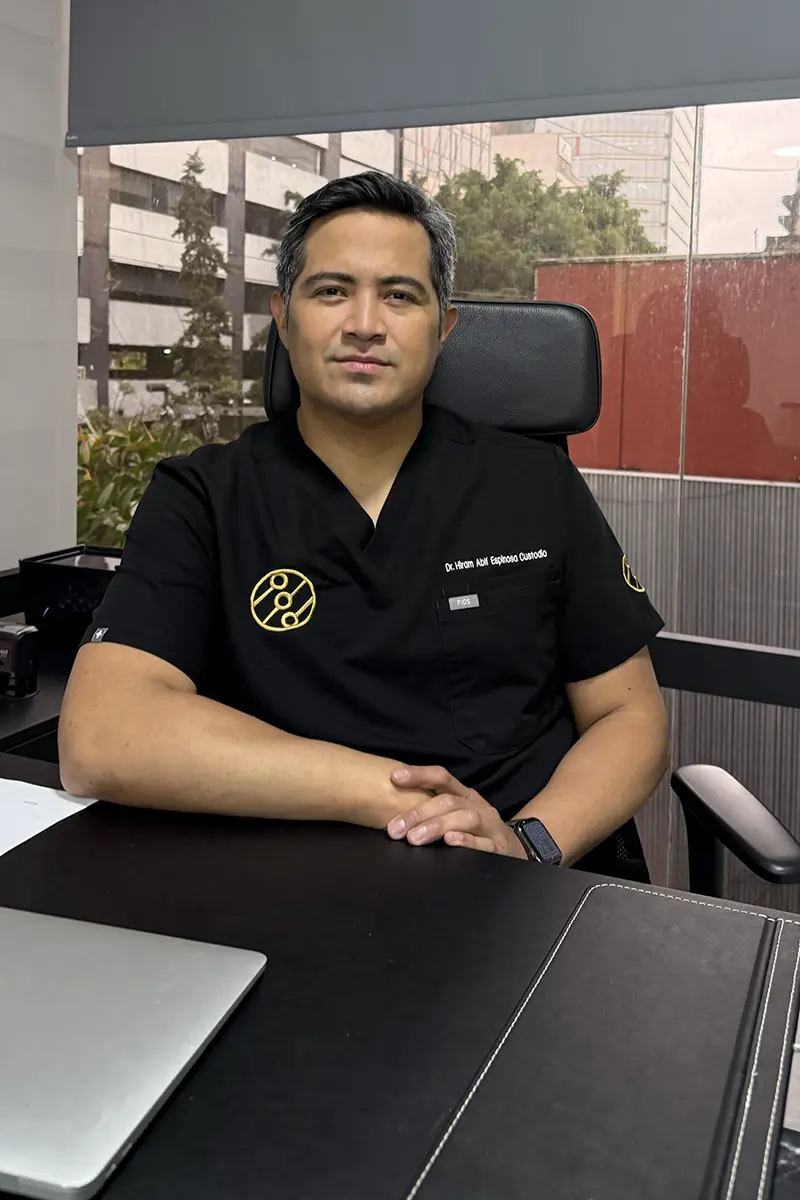

• Performed by Dr. Espinosa Custodio, including both the extraction and the DHI implantation.
• Results with fast recovery, no scars, and no visible thinning.
• Painless treatment, with local anesthesia and the best medical instruments.
Standards of Excellence
- • Written results commitment
- • Diagnosis with doctors and medical design
- • FUE technique specialists
- • Hair transplant with DHI Implantation
- • Pre-operative blood tests and EKG
- • Specialized hair treatment room
- • Post-operative hair washes
- • Follow-up until patient discharge
The Step-by-Step Process
Medical DiagnosisRigorous analysis performed by our doctors, key to guaranteeing a satisfactory and natural result.
Preoperative PhaseSimple guidelines and previous treatment. We perform a complete blood test and EKG for your safety.
Arrival at the ClinicWe start the day early, allowing each preparation to be carried out with calmness and technical precision.
Artistic DesignDr. Espinosa defines the most aesthetic and natural design together with the patient before starting the intervention.
Follicular ExtractionMeticulous obtaining of follicles using the FUE technique, respecting the density of the donor area.
ClassificationThe technical team processes the follicles under a microscope according to the number of hairs for strategic implantation.
PreservationMaintenance in a biotechnological solution at low temperature to guarantee the total viability of the follicle.
DHI ImplantationThe specialist implants each unit in the recipient area following the natural growth angle.
Hair RestorationDelivery of post-operative guidelines and the Hair Restoration Pack for optimal care at home.
After the procedure, we provide the patient with their Restoration Pack and establish a one-year care plan. This plan includes, at no additional cost, any complementary in-clinic treatment sessions necessary to monitor and enhance follicle survival.
FUE – FUSS
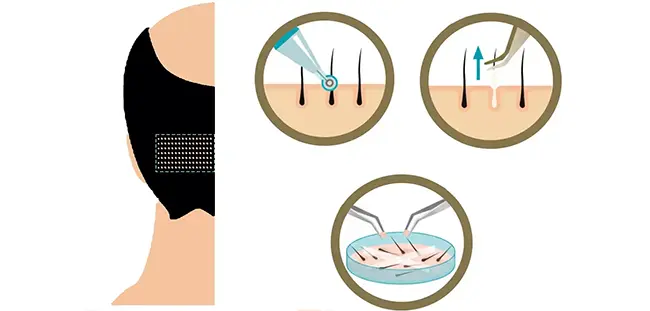
Hair Transplant: FUE Technique
The FUE technique, which stands for Follicular Unit Extraction, consists of extracting follicular units from areas with good hair density, which we call the donor area. These are extracted using a circular scalpel called a punch, which can range from 0.6 to 0.9 millimeters—just enough space to extract the follicular units. This process can be performed manually or with the assistance of a micromotor.
In this technique, the experience and skill of the specialist are crucial. The benefits of this technique include not leaving a scar in the donor area—since the random extraction makes the perception of density loss minimal—as well as a fast recovery. However, your trichologist must diagnose whether you are the ideal candidate for this technique.
Incisions must always be performed by a doctor.
At Instituto Médico del Prado, Dr. Espinosa Custodio and his team apply a protocol to ensure that all follicular units (grafts) extracted from the donor area survive in the recipient area.
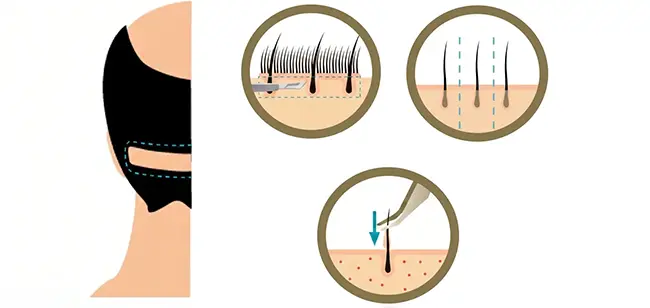
Hair Transplant: FUSS Technique
The FUSS (Follicular Unit Strip Surgery) extraction technique consists of removing a strip of skin from the back of the head. The strip is usually approximately 1 to 3 cm wide and 15 to 20 cm long. Subsequently, the follicular units are separated using specific instruments and microscopes called Mantis, to be implanted using the classic technique or stick and place.
This procedure may leave a residual scar that is hidden by the hair itself. Currently, Dr. Espinosa does not perform this technique as he has specialized in the FUE technique.
IMPLANTATION – WITH DHI TECHNIQUE
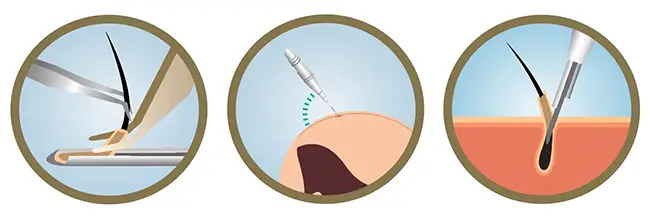
What the DHI Technique in Hair Transplantation Consists of
DHI stands for Direct Hair Implantation. It is the most advanced hair implantation technique for the recipient area, achieving healthier and more natural results. With DHI, hair follicles are implanted one by one directly into the transplant area with the proper direction, angle, and depth using a special DHI implantation tool called an implanter.
This technique provides 100% natural results and guarantees maximum follicle viability. Dr. Espinosa Custodio has been practicing this technique since 2016 and personally performs the entire implantation of all follicles assisted by his team.
Objective
To ensure that the implanted hair is healthier and stronger by reducing the time the grafts remain outside the scalp. Furthermore, no incisions are required during this procedure. It is performed using devices called implanters. These are like small grooved needles through which the follicle is implanted. They can have different diameters depending on the size of the follicle to be implanted, ranging from 0.64 to 1 mm.
Advantages of the DHI technique
- Innovative procedure with natural results, performed by the doctor.
- Better control of the implantation angle and depth. We can orient the transplanted hair at different angles, allowing for a more natural appearance.
- There is a higher survival rate of the follicles.
- We can achieve a hair transplant with greater density than with other techniques.
- No prior incisions are required as hair follicles are transplanted using a special DHI implant tool.
- Existing hair is hardly damaged.
- The transplant area bleeds less, heals faster, and leaves no mark.
- Less damage to the follicular unit during the transplant.
- With the DHI method, between 90-95% of the extracted grafts survive.
FUE – FUSS
FUE TECHNIQUE
Does the FUE technique leave marks or scars?
A scar is not produced as only small wounds occur, which do not even require sutures for healing.
What is the preparation before the intervention?
On the same day of the intervention, you can have breakfast, with the only requirement to avoid consuming coffee or caffeinated beverages.
During the preparation for the intervention, the patient will be provided with an anxiolytic or relaxant to help them feel calmer during the procedure.
Do I have to shave my entire head for the intervention?
Thanks to this technique, the follicles to be extracted from the donor area can be better identified. In all these interventions, part or all of the occipital area of the head is shaved.
However, we should not shave this area ourselves. It will be the specialized technicians at the clinic who carry out this task prior to entering the treatment room. They are the ones who know how to do it so that Dr. Espinosa Custodio can perform his work properly.
Is it possible to avoid shaving?
In these cases, an unshaven hair graft can be performed, which allows the extraction area to be worked on without it being perceptible after the intervention.
On the other hand, it is true that shaving is preferable and this is done for men with short hair.
How long does the FUE intervention last?
The main reason for this two-day technique is to guarantee the survival of the follicles. Transplants are usually planned on two consecutive days. In the case that many follicular units are needed, a third intervention will be required one year after the first ones.
What are the phases of the FUE intervention?
The first phase will be the follicle extraction. Using the FUE technique, Dr. Espinosa Custodio, aided by punches and the micromotor, will extract the follicles one by one. The doctor’s team will then proceed to classify and prepare them so they can be grafted.
Once the extraction is finished, the doctor will proceed to their implantation. This will be done with implanters, which can be described as small grooved syringes through which the follicles are implanted.
Both the punches and the implanters have different diameters. Depending on the size of the patient’s follicle, they will range from 0.6 to 1 millimeter.
What is the recovery from the intervention like?
The appearance we will have during the first days is of multiple small wounds on the head, so it may be convenient, if we can afford it, to take a few days off or work from home. In the first 48 hours, the face may swell due to the effect of the local anesthesia.
After 72 hours, the extraction scars will be closed, and after the first week or ten days, the appearance will be practically normal.
When will I notice the effect of the transplant?
The grafted follicles will start their normal growth cycle and, between 5 and 6 months, we will start to see the first results. However, it will not be until 12 to 15 months have passed that we will see the complete result.
In the case of the vertex, commonly called the crown, the process is slower and it is from 15 months onwards when it will complete its course.
When is the FUE technique appropriate?
FUSS TECHNIQUE
Does the FUSS technique intervention leave a scar?
It is a scar that, however, can be concealed with the patient’s long hair (from 1 or 2 cm) but will be visible if we opt for a shaved or very short haircut.
Is recovery the same as with the FUE technique?
When is the FUSS technique most indicated?
It also reduces treatment time and avoids shaving the hair, making the intervention not so noticeable.
MORE FREQUENTLY ASKED QUESTIONS
What is the best time of year to get a hair graft?
It must also be taken into account that facial edema can occur after the operation, which will resolve after 3 or 4 days. If social interaction is to be avoided, those rest days are also recommended.
Which is the best technique?
In the extraction stage, there are 2 techniques: FUE, where the specialist extracts the follicular units one by one (hair by hair), and FUSS, in which a strip of skin is cut and from there the technicians remove the Follicular Units (FUs).
For implantation, there are also 2 techniques: Classic or forceps, which is a mixed technique where the specialist makes the incisions and the technicians place the follicular units. And the implanter technique (DHI), in which the doctor makes the incision and introduces the follicular unit simultaneously.
It should be remembered that, by law, incisions can only be made by a registered doctor. Dr. Espinosa Custodio will examine you and determine which is the most appropriate technique for you.
What is FUE?
How is a hair transplant performed?
It consists of the extraction of the follicular units (the hair) and the subsequent implantation of these same units in the area to be restored.
Does the hair transplant technique have any risk?
What care should I have after the graft?
Dr. Espinosa Custodio personally explains the care to follow and, subsequently, it is provided in writing. In addition, we have a 24-hour telephone for emergencies.
Does the implanted hair fall out?
Can anything be done to speed up growth?
Does the hair removed from the back grow back?
What are the scabs like after the transplant?
How is the first line of the hair implant drawn?
Therefore, for the first line, follicular units with a single follicle are selected, progressively increasing to two and three, so that the line is natural and a good hairline remains. In addition, the design must always be made according to the morphology of the patient’s face, and it is therefore convenient to listen to the doctor’s recommendations.
Can a scar be covered with a hair transplant?
Can I use hair fibers after the hair transplant?
Can I have a hair graft if I suffer from psoriasis?
When can I dye my hair after the hair transplant?
Can hair fall out during menopause?
Is it possible to perform a transplant with long hair?
Can I have a hair graft if I am a smoker?
How are follicles treated during the hair graft?
When can I cut my hair after the hair transplant?
Am I a candidate for a hair graft?
What is hair graft transection?
Why does the implant in the crown take longer to grow?
Does hair fall out after childbirth?
What is ringworm?
What is folliculitis?
How is diffuse alopecia treated?
What is poliosis?
Does a hair transplant hurt?
How can I prepare for a hair transplant?
Can I have a transplant for scarring alopecia?
Why is a hormonal analysis required?
I suffer from rosacea, can I have a hair graft?
How we work – Instituto Médico del Prado
- • Hair diagnosis with our doctors
- • Using FUE and DHI techniques
- • Commitment to results (see conditions)
- • Pre-operative (complete blood work and EKG)
- • Smart dermatoscope (HairMetrix By Canfield)
- • Follow-up included until discharge
- • Post-operative pack for home care
- • Hair washes after the graft
- • 24-hour telephone assistance
At Instituto Médico del Prado we perform your hair graft (Madrid and Mexico City) with all sanitary guarantees. We are a center specialized in hair transplantation using FUE (Follicular Unit Extraction) and DHI (implanter) techniques.
Dr. Espinosa Custodio has been dedicated to hair transplantation since 2016 and possesses a solid background in this discipline.
Hair transplantation is a long but very rewarding process. Results are not immediate; in hair transplantation, final results can be assessed around a year or a year and a half after the intervention. Dr. Espinosa Custodio commits to his results in writing (see conditions), so that the hair graft meets the patient’s expectations.
Dr. Espinosa usually implants around 2,000 follicular units per session. This condition is part of our excellence protocol, and with it, we ensure that all follicles (grafts) survive in the grafted area. Thanks to this process, we also ensure that all grafts are placed correctly, choosing the direction, depth, and position of each one.
Nevertheless, each patient has characteristics that are studied individually. Always at the doctor’s discretion, sessions can reach 2,500 to 2,600 follicular units.
All transplants performed by Dr. Espinosa Custodio and his team are carried out in his hair clinics in Madrid and Mexico City, Instituto Médico del Prado. He is the one who performs all incisions during the operation (mandatory by law), both in extraction and implantation. We apply the FUE technique for extraction and the DHI technique for implantation, the most advanced methods which require the greatest mastery from the doctor.
The diagnostic consultation for hair transplantation
The beginning of a hair transplant is the trichological diagnosis. Our doctors are responsible for compiling your medical history and diagnosing your hair situation. This determines whether you are a suitable candidate for the transplant.
Our doctors are aided in the diagnosis by a smart trichoscope, Hairmetrix By Canfield. This is an innovative system that analyzes hair density, grafts per square centimeter, and the thickness of follicular units.
If you are a candidate for a hair graft, we will study your donor area to determine how many follicular units can be transplanted, as well as those needed in the recipient area. The doctor will create the most suitable design for you in order to obtain the most natural result.
Diagnostic and assessment consultations with our doctors have an associated cost.
You can also request an initial assessment from the doctor through our online consultation form.
Hair treatments before and after the graft
If you need preliminary treatments to ensure healthy and strong hair before the transplant, we will carry them out in our hair clinics. This is normal and forms part of the hair implant process.
After the transplant, we include all the necessary washes to care for your hair, as well as the removal of scabs a few days later. Additionally, we will provide you with a post-operative hair pack with everything needed to care for your hair: thermal water, regenerating cream, cervical pillow, oral medication, and items for proper hair cleaning.
The months following the transplant are as important as the graft itself. Therefore, the doctor will meet with you periodically and perform the treatments you may need.
Hair Transplant in Madrid
The price is a sliding scale calculated based on the implanted follicular units, from €3 / Follicular Unit (graft) VAT included.
Hair Transplant in Mexico
The price is a sliding scale calculated based on the implanted follicular units, from $65 MXN / Follicular Unit (graft) VAT included.
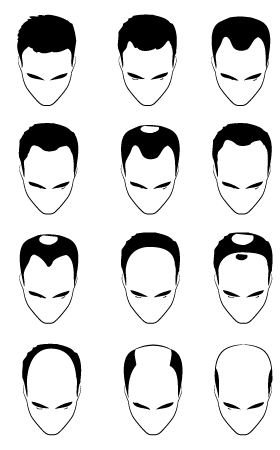
Grade II and IIa
2,000 to 2,500 grafts
Grade III
2,500 to 3,000 grafts
Grade IIIa
3,000 to 3,500 grafts
Grade III vertex
3,500 to 4,000 grafts
Grade IV
4,000 to 4,500 grafts
Grade IVa
4,500 to 5,000 grafts
Grade V
5,000 to 5,500 grafts
Grade Va
5,500 to 6,000 grafts
Grade VI
6,000 to 6,500 grafts
Minisessions
Dr. Espinosa also performs minisessions, which are specifically designed for patients who:
Calculation of Follicular Units
How to calculate follicular units?
In this fairly precise way, we know the follicular units that the patient needs. It should be noted that in addition to this calculation, an analysis of the donor area must be performed to evaluate if the transplant is viable.
The average density so that alopecia is not noticeable is around 50 grafts/cm2, although it varies depending on the area (the front line requires more), hair type, color, and thickness.
Estimation according to Degree of Alopecia
> Grade II a: 2,000 to 2,500 grafts
> Grade III: 2,500 to 3,000 grafts
> Grade III a: 3,000 to 3,500 grafts
> Grade III vertex: 3,500 to 4,000 grafts
> Grade IV: 4,000 to 4,500 grafts
> Grade IV a: 4,500 to 5,000 grafts
> Grade V: 5,000 to 5,500 grafts
> Grade Va: 5,500 to 6,000 grafts
> Grade VI: 6,000 to 6,500 grafts
In the diagnostic consultation, the doctor will indicate the exact figure and the strategy to follow.
Recommendations for Hair Transplantation
Introduction to the Process
Pre-operative Recommendations (Before surgery)
6-9: Avoid stimulants (1 week before). Drink plenty of water. Smoking is prohibited (1 week before): it compromises the survival of the graft.
10-15: Wash your head the morning of the appointment. Do not shave your hair. Wear a button-down or zippered shirt. Eat a normal breakfast (no caffeine). Do not drive after surgery. Blood work and EKG are mandatory.
Post-operative and Recovery
What are the days following the hair transplant like?
Social and work reintegration from the 4th or 5th day.
Immediate Care after the Transplant
Posture and Clothing: Wear loose clothing. Sleep with your head elevated for the first few days (cervical pillow).
Protection: Apply cold to the forehead. No direct sun (15 days). Pool after 3 months, Sea after 2 months.
Sports: Gentle aerobic exercise after 10-15 days. Strength/Gym after 2 months.
Maintenance: Donor Area and Recipient Area
Donor Area
Apply regenerative ointment once a day for one week.
Recipient Area
Constant hydration: Use thermal water every hour during the first week. It is vital for the survival of the follicles.
Washing: Do not wash your head on your own for the first few days; it will be done at the clinic and you will be given instructions for home care with a special shampoo.
International Patients
- Clinic specialized in international patient care.
- Assistance in finding accommodation.
- Natural results.
- Bilingual care in English and Spanish.
- Adaptability to the patient’s needs.

Plan your procedure
Please complete the details below and our medical team will analyze your case on a personalized basis.
BASIC INFORMATION ABOUT DATA PROTECTION OF CAPILLAR MEDICINE BY DR. ESPINOSA CUSTODIO
Responsible: Hiram Abif Espinosa Custodio, Instituto Médico del Prado. Purpose: To process and manage your request, respond to your medical or informational inquiries, and, where applicable, send you communications related to our services in the field of hair medicine. Legal basis: Consent of the data subject. Recipients: Your data will not be shared with third parties except where legally required. In the case of international data transfers, your information may be processed in Spain and/or Mexico by the controller, with the same protection safeguards. Rights: You may exercise your rights of access, rectification, erasure, objection, restriction of processing, and data portability, as well as withdraw your consent at any time by sending an email to info@drespinosacustodio.com. Additional information: You can find the full details on how we process your data in our Privacy Policy.