


The hair
Basic concepts
Hair anatomy
Hair is a skin appendage that covers a large part of the body. It consists of two main parts: the root, located inside the skin, and the shaft, which is the visible part.
The root is located in the hair follicle, a skin structure at the base of which is the hair bulb, where hair is formed.
Hair follows different growth directions that can form whorls, especially visible on the crown.
Each hair follicle is associated with a small arrector pili muscle which, when contracted, causes the hair to stand up and produces the effect known as “goosebumps”.
Types of hair
Hair covers most of the body, except for certain areas such as the palms of the hands and the soles of the feet. Depending on its characteristics, we mainly distinguish two types:
- Terminal hair: it is thicker and pigmented. It is found on the scalp, eyebrows, eyelashes, beard, armpits, and pubic area.
- Vellus hair: it is finer, shorter, and generally less pigmented. It is present in numerous areas of the body.
The hair that covers the scalp is specifically referred to as scalp hair.
Scalp hair
Scalp hair is one of the types of hair that reaches the greatest length due to the duration of its growth phase.
Its thickness, shape, color, and density vary among individuals and are mainly determined by genetic, hormonal, and age-related factors.
These characteristics influence both its appearance and the progression of certain hair disorders.
Hair growth
Hair grows approximately between 1 and 1.5 centimeters per month, although this rate can vary depending on the individual. Its growth follows a cycle composed of three main phases:
- Anagen phase: this is the stage of active growth. On the scalp, it usually lasts between two and six years and comprises approximately 85–90% of the hairs.
- Catagen phase: this is a transition stage during which hair growth stops. It lasts approximately two to three weeks and affects a small proportion of follicles.
- Telogen phase: this is the resting stage, which lasts approximately two to three months. At the end of this phase, the hair sheds and a new growth cycle begins.
Shedding between 50 and 100 hairs per day can be considered normal, although there are individual and seasonal variations.
Hormones and hair
Hormones play an important role in hair growth and hair loss, both in men and women.
In androgenetic alopecia, hair follicles have a genetic sensitivity to androgens, especially dihydrotestosterone (DHT).
This sensitivity varies among individuals and across different areas of the scalp. The frontal and upper regions are usually more susceptible, whereas follicles in the occipital and lateral areas generally show greater resistance.
Other hormones, such as thyroid hormones, estrogens, and prolactin, can also influence the hair cycle.
The alopecia
Alopecia
Hair shedding is part of its natural renewal cycle. However, when excessive loss or a progressive decrease in density occurs, some type of alopecia may be present.
Alopecia can affect specific areas of the scalp or present diffusely. Depending on its cause, it may be temporary or permanent.
An accurate diagnosis makes it possible to identify the type of alopecia and evaluate the available treatment options.
Baldness
Baldness is a form of hair loss characterized by a progressive decrease in density or the absence of hair in certain areas of the scalp.
Its most common cause is androgenetic alopecia, which affects both men and women, although it usually presents differences in its distribution and progression.
Trichology is the medical discipline dedicated to the study of hair, the scalp, and their disorders. Since there are different types of alopecia, it is essential to establish an accurate diagnosis before recommending any treatment.
Baldness causes
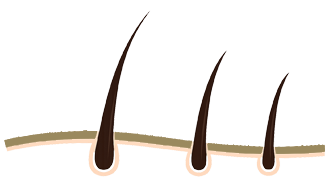
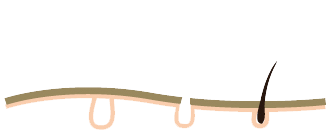
- Androgenetic alopecia: related to genetic predisposition and follicle sensitivity to androgens. It causes a progressive miniaturization of the hair.
- Autoimmune diseases: certain immune system disorders, such as alopecia areata or certain forms of lupus, can cause hair loss.
- Physical or emotional stress: situations of intense stress, illnesses, or surgical procedures can temporarily alter the hair growth cycle.
- Trichotillomania: a disorder characterized by the recurrent urge to pull out one’s own hair.
- Medications: certain pharmacological treatments can cause hair loss as a side effect.
- Infections: some scalp infections, especially fungal infections, can cause hair loss.
- Hereditary diseases: certain genetic and dermatological conditions can affect hair development and growth.
Identifying the cause is essential to establish the most appropriate treatment.
Male alopecia
Male alopecia
Androgenetic alopecia is the most common cause of hair loss in men. Its onset can begin at an early age, and its frequency increases over the years.
It generally follows a characteristic pattern, starting with a receding frontal hairline at the temples, and may extend toward the top of the scalp and the crown. Its progression varies considerably among patients.
Causes
Mainly related to genetic predisposition, the action of androgens, and age. Hair follicles in susceptible areas have a higher sensitivity to dihydrotestosterone (DHT), which promotes their progressive miniaturization.
This process involves the 5-alpha-reductase enzyme, responsible for converting part of the testosterone into dihydrotestosterone. Certain medical treatments target this mechanism.
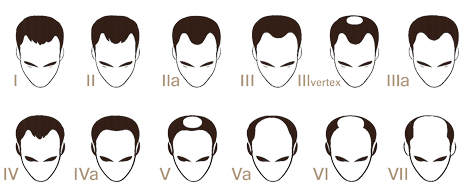
Hamilton-Norwood Classification
Androgenetic alopecia has a typical evolution that progresses similarly in all men. In 1951 James Hamilton described a classification of male alopecia that included 8 evolutionary stages. In 1975 Norwood revised that classification and introduced some subclassification that detailed more the one carried out by Hamilton. It is currently the most used classification and on which the diagnosis of androgenetic alopecia in men is based.
On the Hamilton-Norwood scale, 7 levels of baldness differ:
- Type I: preserved frontal hairline or minimal recession.
- Type II: mild recession of the frontal hairline, especially in the temporal regions.
- Type III: more pronounced temple recession. Crown involvement may be present.
- Type IV: greater hair loss in the frontal area and the crown, with a band of hair still separating both regions.
- Type V: progressive thinning of the band of hair separating the frontal area from the crown.
- Type VI: merging of the frontal and crown hair loss areas.
- Type VII: extensive hair loss, retaining hair mainly in the lateral and occipital regions.
Female alopecia
Female alopecia
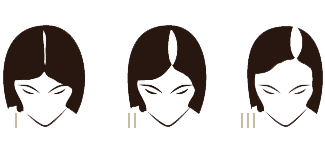
One of the most common causes is female pattern hair loss, which usually manifests as a progressive reduction in density on the top of the scalp. Unlike male alopecia, the frontal hairline is generally preserved, and a widening of the central part is observed.
Causes
Related to a combination of genetic, hormonal, and age-related factors. In some cases, hormonal imbalances may be present, although many women have androgen levels within normal limits. Hormonal changes during menopause can also play a role. Therefore, it is important to perform an individualized medical assessment.
Classification
- Grade I: mild decrease in density, mainly along the central part.
- Grade II: moderate loss of density, with greater visibility of the scalp.
- Grade III: significant reduction in density on the top of the head.
Postpartum Alopecia
After childbirth, the drop in hormone levels can cause temporary hair shedding known as postpartum telogen effluvium. It usually begins between two and four months after delivery and, in most cases, improves progressively over the following months. If it persists or is severe, a medical assessment is recommended.
Other alopecias
Difusse alopecia
It is characterized by a generalized decrease in hair density, not necessarily limited to a specific area. It may be related to hormonal imbalances, nutritional deficiencies, illnesses, physical or emotional stress, and certain medications. In many cases, it is reversible, especially when the underlying cause is identified and corrected. However, its progression depends on the diagnosis and the characteristics of each patient.
Alopecia areata
It is an autoimmune disease in which the immune system attacks the hair follicles, causing hair loss. It usually manifests as round hairless patches. In some patients, it can affect the entire scalp (alopecia areata totalis) or all body hair (alopecia areata universalis). Its course is variable: spontaneous recovery may occur, although persistent or recurrent cases also exist.
Traumatic or Traction Alopecia
Traction alopecia occurs when hair is repeatedly subjected to excessive tension, as can happen with certain very tight hairstyles. There is also hair loss related to trichotillomania, characterized by the recurrent urge to pull out one’s hair. Identifying and correcting the cause is important to prevent permanent damage to the hair follicles.
Cicatricial (Scarring) Alopecia
It encompasses different diseases and processes that cause the destruction of hair follicles and their replacement with scar tissue. It can appear as a result of inflammatory diseases, infections, injuries, or certain surgical procedures. Hair loss is usually permanent in areas where the follicle has been destroyed. Therefore, early diagnosis is especially important.
Frontal Fibrosing Alopecia
It is a form of cicatricial alopecia that mainly affects women, especially after menopause, although it can also occur in other groups. It is characterized by the progressive recession of the frontal hairline and may be accompanied by hair loss in the eyebrows and other areas of the body. Its progression is variable, making early diagnosis and proper medical follow-up essential to help control its progression.
WE EVALUATE YOUR CASE
Request a medical assessment
Complete the details below and our medical team will analyze your case individually.