

Telogen Effluvium and Its Different Causes
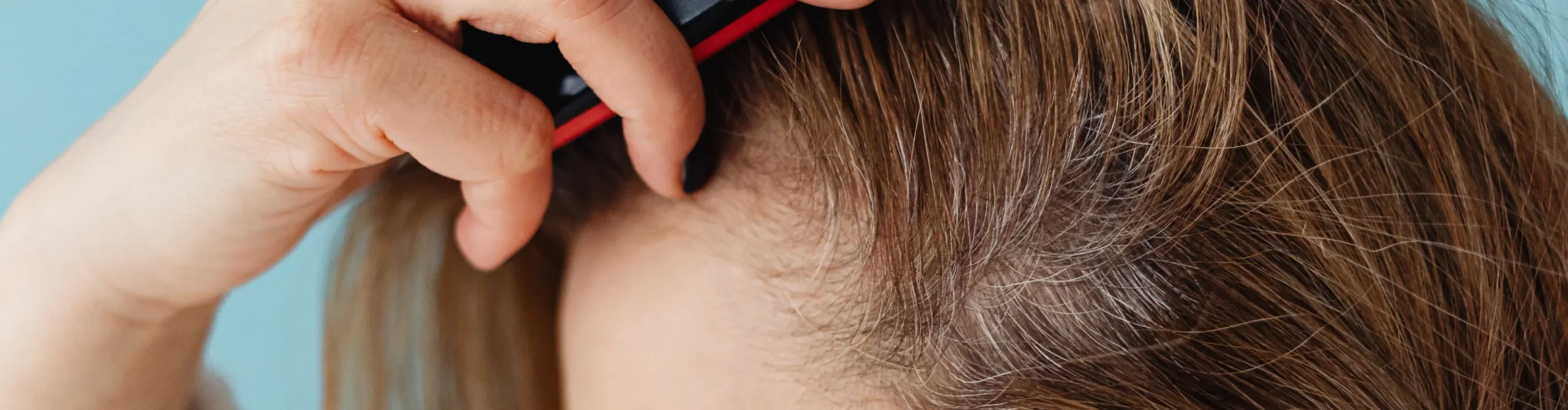
Hair loss is a common phenomenon that can occur at any stage of life. As it is a symptom associated with various diseases and risk factors, its management requires a comprehensive diagnosis to identify and address its underlying causes. Among the most frequent conditions causing hair loss are alopecia areata, androgenetic alopecia, and telogen effluvium.
In this article, we will focus on telogen effluvium, reviewing its main causes, its etiopathogenesis, its relationship with different diseases, and current treatment options.
Contents
- Telogen effluvium: how can I identify it?
- What factors trigger this phenomenon?
- Hormonal alterations
- Nutritional deficiencies
- Is it reversible?
- Frequently asked questions
- References
1. Telogen effluvium: how can I identify it?
Telogen effluvium is one of the most common causes of hair loss in patients attending their first consultation. It is characterized by excessive and diffuse hair shedding, without visible signs of disease on the scalp and without follicular miniaturization, which helps differentiate it primarily from androgenetic alopecia.
But what can be done to stop the hair loss? The key lies in timely diagnosis. During consultation, we carry out a detailed medical history to identify possible triggering factors and perform a scalp examination using a dermatoscope, a fundamental tool for accurate evaluation and differential diagnosis. It is essential to request complementary tests to confirm the diagnosis and determine the most appropriate treatment.
2. What factors trigger this phenomenon?
Many factors can trigger this condition, ranging from pharmacological treatments and episodes of physical stress to environmental elements such as seasonal changes, travel, or even water quality.
However, beyond these general causes, it is particularly important to focus on certain common medical conditions. In our clinical experience, these are often found incidentally during consultation, as in many cases they do not produce obvious symptoms. Nevertheless, with proper diagnostic judgment, they can be easily identified and addressed in a timely manner.
3. Hormonal alterations
Among hormonal alterations, thyroid hormones stand out in particular. These play a fundamental role in human physiology, regulating key processes such as metabolism, cellular regeneration, and the body’s energy balance. Their impact goes far beyond internal organs—both skin and hair are directly influenced by their proper function.
When there is a disorder of the thyroid gland, such as hyperthyroidism or hypothyroidism, various clinical manifestations may appear. Among them, diffuse hair loss—present in up to 50% of patients—stands out and is known as telogen effluvium. In many cases, this hair loss may be one of the first clinical signs and should not be overlooked.
When these processes are disrupted, the impact on hair may manifest in different ways:
- Generalized or diffuse hair loss
- Changes in pigmentation due to reduced melanin production and distribution
- Decreased hair growth rate
- Reduced production of new hair fibers, affecting density and volume
- Dry, dull, and brittle hair with increased susceptibility to damage
5. Is it reversible?
In many cases, yes. Hair loss associated with the aforementioned conditions is usually reversible once the hormonal or nutritional imbalance is corrected. In fact, most triggers of telogen effluvium can be resolved if identified and treated in time.
However, it is important to note that hair regrowth occurs gradually, and full recovery may take several months after hormonal levels have stabilized.
For this reason, we recommend consulting a specialist at the first signs of alopecia or a noticeable increase in hair shedding. An accurate diagnosis, supported by appropriate tests, is essential to identify the cause and establish the most effective treatment.
6. Frequently asked questions
How can I differentiate telogen effluvium from other types of hair loss?
It is characterized by diffuse and excessive hair shedding, without well-defined bald patches or visible signs of scalp inflammation. Unlike androgenetic alopecia, there is no follicular miniaturization. Diagnosis is confirmed through clinical evaluation, dermatoscopy, and, in many cases, complementary tests.
- What are the most common causes of telogen effluvium? It can be triggered by multiple factors, including physical or emotional stress, illnesses, medications, seasonal changes, or travel. However, hormonal imbalances (especially thyroid disorders) and nutritional deficiencies, such as low iron or vitamin D levels, are among the most common causes.
- Can thyroid disorders cause hair loss? Yes. Both hypothyroidism and hyperthyroidism can lead to diffuse hair shedding known as telogen effluvium. In many cases, it may even be one of the first clinical signs, so assessing thyroid function is important in persistent hair loss.
- Is telogen effluvium reversible and how long does recovery take? In most cases, it is reversible. Once the underlying cause is identified and treated, hair regrowth begins gradually. However, the process is slow, and full recovery may take several months after the imbalance has been corrected.
This content has been prepared by the medical team at Instituto Médico del Prado and reviewed by Dr. Bonilla Juárez and Dr. Gallardo Madrid.
Dr. Espinosa Custodio works at the Instituto Médico del Prado, his hair clinic in Madrid and Mexico City. If you would like to schedule an appointment, you can contact us by phone at 912 468 664, via WhatsApp at 627 396 322, or through the contact page on our website. If you are contacting us from Mexico, our phone number is +52 55 4590 9909.
7. References
- Aguero-Zaputovich M, Aguilar Naville S. Telogen effluvium: Literature review. Gacet Dermatol. 2022.
- Palma-Peña S, Vivas-O’Connor V. Telogen effluvium. Piel. Form Contin Dermatol. 2024;39(8):487–494.
- Hussain F Asghar et al. Telogen Effluvium: A Review of the Literature. Cureus. 2020;12(5):e8320.
- Karakoyun Ö, et al. Retrospective review of 2,851 female patients with telogen effluvium. PMC. 2025.
SUSCRÍBASE AL BLOG
Reciba noticias, promociones e información relevante sobre los servicios y tratamientos del Instituto Médico Del Prado.