

Oral Medication and Hair Transplantation: Does It Make Sense to Operate Without Treatment?
Before addressing the relationship between oral medication and hair transplantation, it is useful to briefly review androgenetic alopecia and its treatment.
Index
- What is androgenetic alopecia?
- Antiandrogens: finasteride and dutasteride
- Minoxidil: how it works
- Safety and potential side effects
- Regulation (FDA and EMA)
- Combination therapy
- Does a transplant make sense without medication?
- What medication do we use before and after the transplant?
- Can oral medication be replaced?
- Scientific evidence: hair transplantation with and without oral medication
- Frequently asked questions
What is androgenetic alopecia?
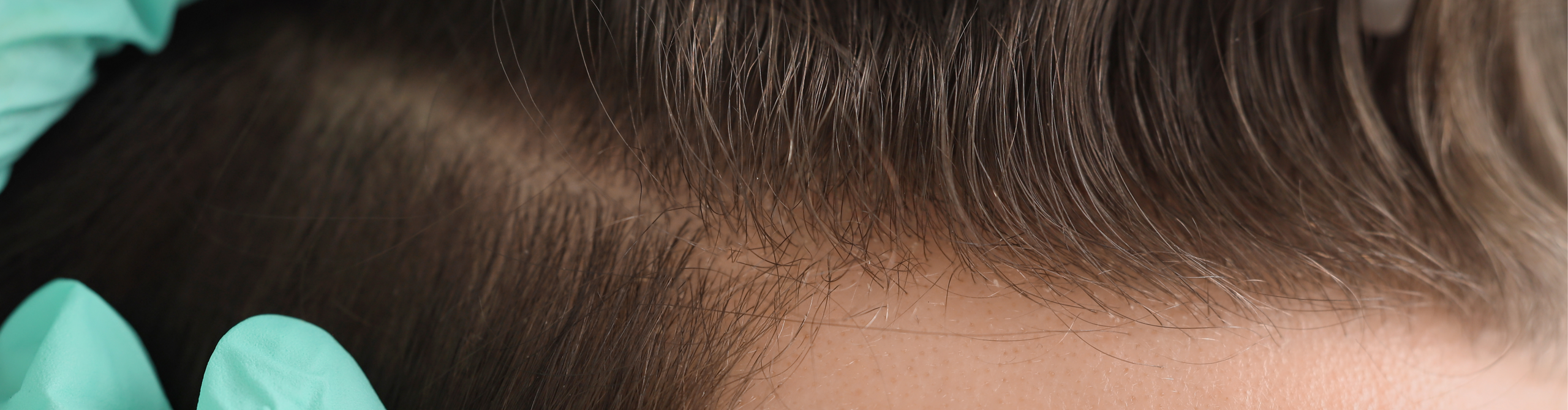
Androgenetic alopecia is the most common cause of hair loss in both men and women. It does not appear suddenly but follows a progressive process. In genetically predisposed individuals, hair follicles respond to dihydrotestosterone (DHT) and gradually become smaller. This is known as miniaturization.
This is something we see daily in consultation, both in Madrid and Mexico City: patients who interpret areas with fine hair as “lost,” when in fact miniaturized hair is still present and may improve with medical treatment.
Hair progressively loses thickness, density, and duration in its growth phase. In more advanced stages, the follicle may stop producing visible hair.
Therefore, it is important to understand that treatment does not aim to create new hair, but to slow the process and preserve hair that is still recoverable.
Antiandrogens: finasteride and dutasteride
Within the treatment of androgenetic alopecia, antiandrogens are the cornerstone. They act on the 5-alpha reductase enzyme, reducing the conversion of testosterone into DHT.
- Finasteride primarily acts on type II.
- Dutasteride acts on both type I and type II.
This has clinical implications depending on the pattern of alopecia. Their main effects are:
- Slowing progression.
- Stabilizing miniaturization.
- Preserving existing hair.
They do not generate new hair in completely bald areas, but they significantly modify the course of alopecia.
Minoxidil: how it works
Minoxidil acts directly on the hair follicle.
- Improves vascularization.
- Prolongs the growth phase.
- Increases follicle size.
- Improves hair shaft caliber.
- Stimulates still-active follicles.
It has also been linked to the Wnt/β-catenin pathway, which is involved in the hair cycle.
In practice, it helps improve hair quality and the environment in which it grows.
Safety and potential side effects
This is one of the main concerns for patients.
Antiandrogens may be associated with side effects, mainly in the sexual sphere. They are not common, but they must be explained and assessed on a case-by-case basis.
In the case of oral minoxidil, the most common effects may include:
- Hypertrichosis.
- Fluid retention.
- Palpitations.
- Changes in blood pressure.
In practice, when treatment is properly indicated, most patients tolerate it well. If side effects appear, they can usually be managed by adjusting the dose.
Regulation (FDA and EMA) for treating alopecia
- Topical minoxidil and finasteride are approved for androgenetic alopecia.
- Oral minoxidil and dutasteride are used off-label.
When we talk about regulation, we refer to official bodies that evaluate the safety and efficacy of medications: the FDA (Food and Drug Administration) is the regulatory agency in the United States, and the EMA (European Medicines Agency) is the regulatory body in the European Union.
Off-label use is common when there is sufficient scientific evidence and clinical experience.
Combination therapy
In clinical practice, the best approach for the treatment in androgenetic alopecia is usually combined. Antiandrogens act on the hormonal cause, while minoxidil acts on the follicle. This combination allows:
- Stabilization of alopecia.
- Preservation of native hair.
- Improvement of hair quality.
- Better preparation of the patient if a hair transplant is considered.
This reinforces the importance of integrating medical treatment as part of the standard management of patients undergoing hair transplantation.
Does a hair transplant make sense without medication?
This is one of the most common questions. Many patients present with a high degree of miniaturization, assuming that surgery is the only solution. However, this is not always the case.
Technically, a hair transplant can be performed without medication, but in many cases it is not advisable.
If alopecia is not treated:
- The condition continues to progress.
- Native hair is lost.
- The result may appear less natural over time.
Rather than a simple yes-or-no answer, this is a matter of proper case planning.
What medication do we use before and after the transplant?
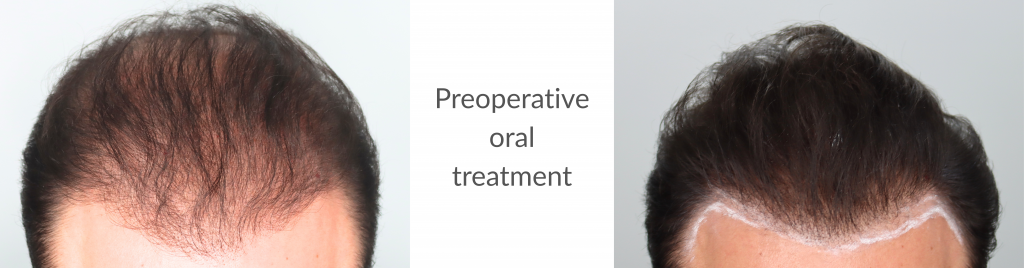
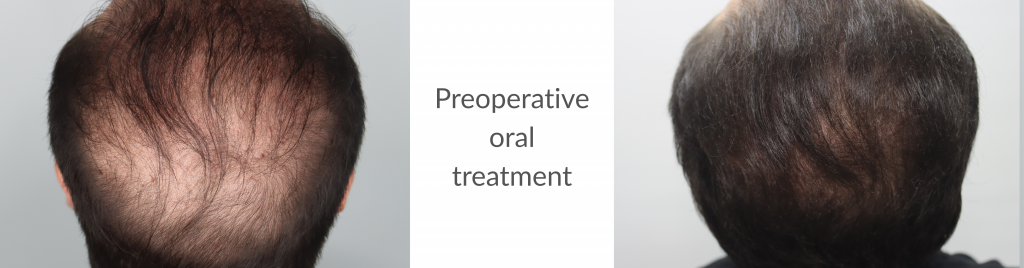
Oral medication and hair transplantation are part of the same therapeutic approach. Medical treatment not only slows alopecia but also:
- Prepares the follicle for surgical stress.
- Improves graft survival.
- Optimizes the growth environment.
- Helps maintain long-term results.
A combination is typically used:
- Antiandrogen (finasteride or dutasteride).
- Minoxidil.
The antiandrogen slows progression, while minoxidil improves hair quality.
Without this foundation, follicles may be more vulnerable and results less stable over time.
Can oral medication be replaced?
Many patients ask whether oral medication can be replaced with topical or intradermal treatments. At present, the answer is not completely. Treatments such as hair mesotherapy can be useful as a complement, but they do not replace the effect of systemic treatment.
It is important to understand that these treatments require greater consistency, tend to have lower adherence, and must be paused around the time of the transplant, reducing their effectiveness. For this reason, at Instituto Médico del Prado we recommend them as supportive therapies within a comprehensive treatment approach for androgenetic alopecia.
Scientific evidence: hair transplantation with and without oral medication
Medical treatment for androgenetic alopecia has a solid scientific basis, supported by multiple studies, reviews, and meta-analyses.
In the context of hair transplantation, there is evidence reinforcing the importance of oral medication as part of treatment.
In a recent comparative study*, 60 patients with grade III–V androgenetic alopecia undergoing hair transplantation were evaluated. Half of the group received finasteride 1 mg daily for 12 months, while the other group received no treatment.
The results showed relevant differences between the groups. Patients treated with finasteride had:
- Higher follicular survival.
- Greater final hair density.
- Better overall aesthetic results.
- Lower incidence of postoperative shock loss.
Shock loss is a temporary shedding that may occur after surgery, when follicles enter a stress phase. In patients without medical treatment, follicles are more vulnerable, and this shedding may be more noticeable in the first months.
These findings support the idea that medication not only affects the progression of alopecia but also influences the quality and stability of the result after hair transplantation.
*Reference:
Kishen A, S John R, Krishnan M, Kumar S. Post Operative Finasteride Following Hair Transplant Compared with no Medication: A Prospective Comparative Study. Journal of Chemical Health Risks. 2025.
Frequently asked questions
Can a hair transplant be done without medication?
Yes, it is possible. However, in many cases it is not the most advisable approach. If alopecia is not treated, native hair may continue to be lost over time, and results may become less stable.
What is more important, oral medication or hair transplantation?
They are complementary. The transplant redistributes hair, and medication helps maintain the result. Using only one of the two usually limits the outcome.
When should medication be started?
It is typically initiated before the transplant, following a medical evaluation.
Is oral medication lifelong?
In most cases, yes, it should be maintained.
Does medication improve transplant results?
Yes. It improves hair quality and helps ensure more stable long-term results.
Final note
Hair transplantation redistributes hair.
Medication stabilizes alopecia.
When both are combined:
- Results are optimized
- Native hair is preserved
- Greater long-term stability is achieved
Content developed by the medical team at Instituto Médico del Prado and reviewed by Dr. Bonilla Juárez and Dr. Muñoz Ramírez.
Bibliography
- Kishen A, S John R, Krishnan M, Kumar S. Post Operative Finasteride Following Hair Transplant Compared with no Medication: A Prospective Comparative Study. Journal of Chemical Health Risks. 2025.
- Olsen EA, Whiting D, Bergfeld W, et al. A randomized clinical trial of finasteride 1 mg in men with androgenetic alopecia. Journal of the American Academy of Dermatology. 2002;47(3):377–385.
- Kaufman KD, Olsen EA, Whiting D, et al. Finasteride in the treatment of men with androgenetic alopecia. Journal of the American Academy of Dermatology. 1998;39(4):578–589.
- Rossi A, Cantisani C, Melis L, et al. Minoxidil use in dermatology, side effects and recent patents. Recent Patents on Inflammation & Allergy Drug Discovery. 2012;6(2):130–136.
- Gupta AK, Charrette A. The efficacy and safety of 5-alpha reductase inhibitors in androgenetic alopecia: a systematic review and meta-analysis. Journal of Dermatological Treatment. 2014;25(2):156–161.
- Gupta AK, Talukder M. Efficacy and safety of low-dose oral minoxidil for androgenetic alopecia: a systematic review. Journal of the American Academy of Dermatology. 2021;84(3):737–746.
- Ramos PM, Sinclair RD. Management of androgenetic alopecia: a review. Dermatologic Clinics. 2015;33(1):1–12.
SUSCRÍBASE AL BLOG
Reciba noticias, promociones e información relevante sobre los servicios y tratamientos del Instituto Médico Del Prado.