


Hair Transplant Restoration
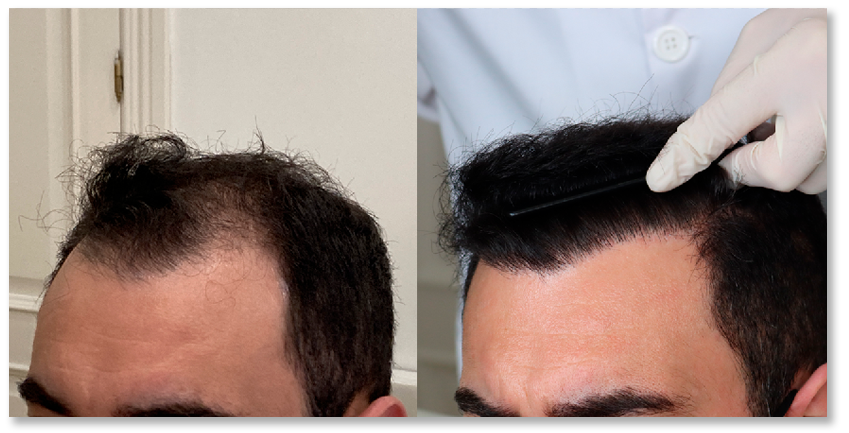
At the Instituto Médico del Prado, we treat all types of patients. Men and women of all ages place their trust in Dr. Espinosa Custodio to improve their hair condition. Some patients come to us after having previously undergone a hair transplant at another clinic. When the outcome has not met their expectations, they seek a better result. In these cases, a hair transplant restoration procedure may be performed.
In these situations, Dr. Espinosa Custodio and Dr. Gallardo Madrid see the patient during the diagnostic assessment consultation to determine the best possible solution. Even after a previous hair transplant, several treatment options may still be available.
Diagnosis with the Doctor
During the initial diagnostic consultation, the doctor will carry out a comprehensive assessment of your hair condition. Using an advanced digital dermatoscope, Hairmetrix by Canfield, the density of each area of the scalp will be analysed. The doctor will also assess the growth stage of the hair follicles and determine whether any follicular miniaturisation is present.
Thanks to the report generated by the system, it can be determined whether the patient is a suitable candidate for a hair transplant.
Medication and Treatments
In a high percentage of cases, Dr. Espinosa Custodio may prescribe oral medication and combine it with intradermal treatments. This serves as preparation for the next surgical procedure.
As a result of the prescribed medication, the hair condition will improve. These drugs will not generate new follicles in areas where hair was previously lost. However, the existing follicles will become healthier. After several months of treatment, follicular thickening occurs. This achieves two goals: donor area follicles will have a higher survival rate, and recipient area follicles, being thicker, will contribute to greater density.
Additionally, intradermal hair treatments such as Mesotherapy or Platelet-Rich Plasma (PRP) may be recommended. Their purpose is similar to pharmacological treatment.

Hair Transplant
Restoration
If Dr. Espinosa Custodio determines that the patient is a suitable candidate for a hair transplant restoration, the procedure will be scheduled. In these cases, the surgery is more complex for the surgeon, as the donor area has already undergone previous intervention and is working with scar tissue. The surgeon’s expertise becomes even more critical. Follicle selection is more limited, and implantation must be performed with high precision to achieve an optimal result.
In any case, after the procedure is completed — which takes approximately 18 months — the hair condition will improve, provided that all post-operative recommendations and care instructions are followed.
The price of hair transplant restoration surgery is higher compared to the initial hair transplant. As with beard, scar, and eyebrow procedures, as well as mini-sessions or small surgeries, pricing starts from €5 per graft.
Scalp
Micropigmentation
Another alternative or complement to hair transplantation is scalp micropigmentation. This technique involves the injection of pigments into the skin to create a visual effect of hair density similar to that of natural hair.
Micropigmentation must be performed by a qualified professional, with prior testing to rule out any allergic reactions. In addition, only high-quality, certified pigments should be used to match the colour of the patient’s hair as closely as possible.
Frequently Asked Questions – Hair Transplant Repair & Revision
Can an unnatural or 'pluggy' frontal hairline from a previous clinic be corrected?
Yes. Through specialized revision surgery, Dr. Espinosa Custodio redesigns the frontal hairline, extracts poorly angled multi-hair grafts to re-implant them as single follicles, and restores a soft, natural transition.
What if my donor area was overharvested during a previous low-cost procedure?
We perform an exhaustive digital trichoscopy with Canfield HairMetrix to calculate your exact remaining occipital reserve and evaluate whether Body Hair Transplant (BHT) from the beard or complementary scalp micropigmentation is advisable.
How long should I wait after a failed hair transplant before undergoing repair surgery?
Medically, we recommend waiting at least 10 to 12 months after the previous intervention so that dermal tissue healing stabilizes and true graft survival can be accurately assessed.
WE EVALUATE YOUR CASE
Request a medical assessment
Complete the details below and our medical team will analyze your case individually.